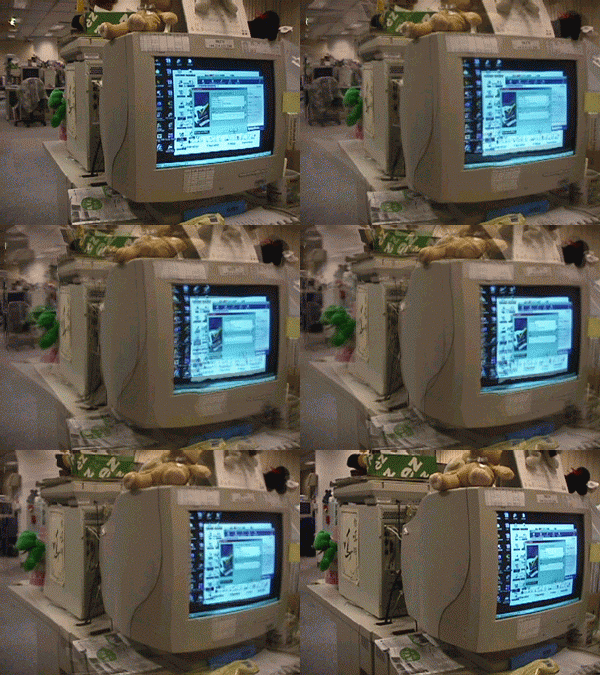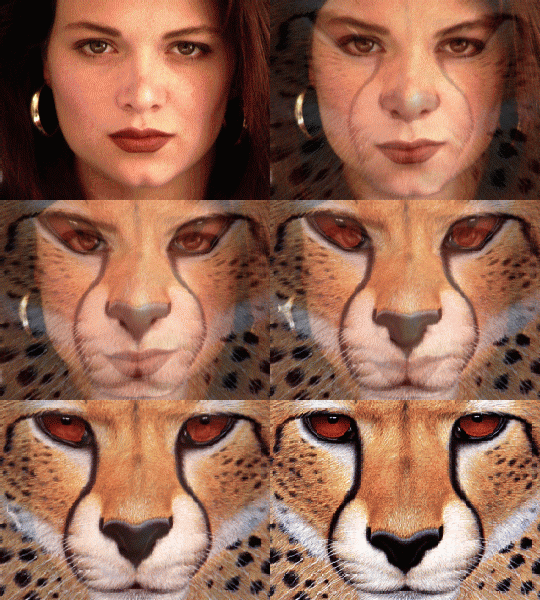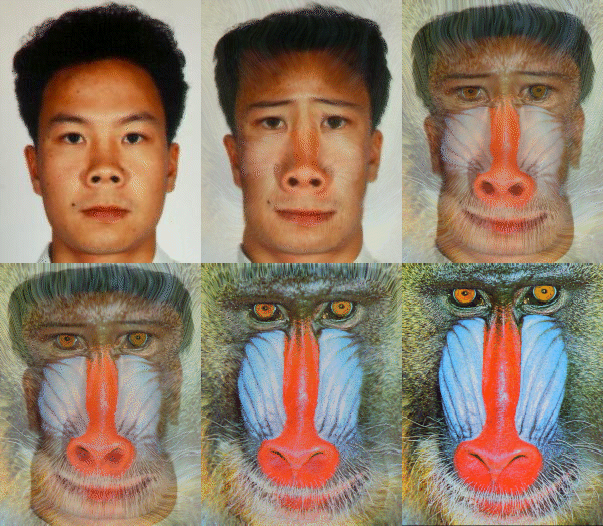
Image warping is the geometrical mapping of an image from one spatial domain (the source shape) onto another (the target shape). The operations involved include spatial transformation, resampling and antialiasing. Various image warping techniques have been proposed. They can be categorized into three main types of methods: patch-based, point-based and vector-based warping methods.
In patch-based warping, both spatial domains of the source image and the target image are subdivided into small patches. The image is warped by transforming each patch of the source to its corresponding patch of the target. In point-based warping, important points are used as the basic corresponding mapping features. Different interpolation functions have been developed to interpolate through all feature points. Vector-based warping techniques use vector pairs as the basis of the warping transformation. The displacement of any point in the image is then a weighted sum of the mappings due to all specified vector feature pairs.
Most of the above techniques, in particular the vector-based warping technique, can warp objects of arbitrary shapes to another with reasonable or desirable outputs. However, they generally suffer from two limitations. First, very often we may need to warp objects of arbitrary shapes and with inner features. One of the main concerns is the warping of the boundary contours of the objects in a controllable way. To handle this with existing methods is difficult. One way to do it may be to perform multiple warping operations to warp the features one at a time. However, individual warping operations are bounded to affect each others. Second, if a fine approximation is required, the matching of corresponding pairs in existing methods may be very time consuming. This is because they are not based on mapping contours and the computational cost is proportional to the number of feature pairs specified.
In this project, our objective is to develop a user oriented warping technique. Therefore, the user should have more control on specifying how the objects are to be warpped and the warping method should be close to interactive. We have developed a contour-based warping technique called the wave propagation method. The method warps objects with arbitrary contours in a manner similar to wave propagated from the defined feature contours. The new method has three major advantages as follows:
Publications: