Mobile Crowdsensing
Summary
Today's smartphones and wearable devices have embedded a rich set of sensors, such as cameras, microphones, global positioning systems (GPS), thermometers, and accelerometers. It enables a new sensing paradigm, called mobile crowdsensing (MCS), where a large number of individuals use their mobile devices to collectively extract and share information related to a certain phenomenon of interest. Typical applications include traffic jam alerts, wireless indoor localization, and small cell network monitoring.The goal of this project is to design economic mechanisms for the efficient operations of MCS from both the perspectives of the service provider and users.
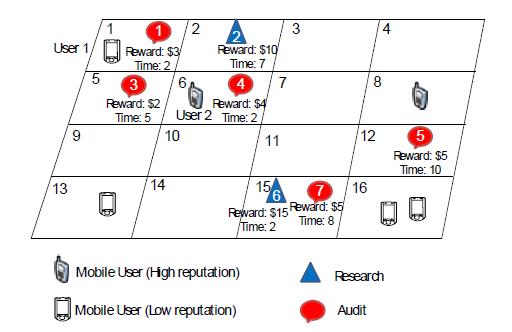
The following projects are related to the incentive mechanism and algorithm design in MCS:
- Reward mechanism design for diversity-driven social MCS: In [1], we considered both the impact of user diversity and social effect in the reward mechanism design. We formulated the interactions between the service provider and the users as a two-stage Stackelberg game, and derived the optimal reward as the Katz centrality of the superimposed graph of the diversity and social relationship in closed-form.
- Distributed time-sensitive task selection algorithm: In [2], we considered the time-sensitive and location-dependent task selection problem motivated by commercial MCS applications. We proposed an asynchronous and distributed task selection algorithm to coordinate the task selection decisions among multiple heterogeneous participants.
- Incentive mechanism design for delay-sensitive MCS: In [3], we focused on the data reporting aspect in MCS and designed a network selection algorithm to enable a more cost-effective data uploading process for MCS applications with deadline constraint. We also formulated the service provider’s reward optimization problem under the incomplete information of the users’ Wi-Fi availabilities.
Selected Publications
-
Man Hon Cheung, Fen Hou, and Jianwei Huang, "Make a Difference: Diversity-Driven Social Mobile Crowdsensing," accepted for publication in IEEE Infocom (acceptance rate 20.93%), Atlanta, GA, May 2017.
-
Man Hon Cheung, Richard Southwell, Fen Hou, and Jianwei Huang, “Distributed Time-Sensitive Task Selection in Mobile Crowdsensing,” in Proc. of ACM International Symposium on Mobile Ad Hoc Networking and Computing (MobiHoc) (acceptance rate 14.8%), Hangzhou, China, June 2015.
-
Man Hon Cheung, Fen Hou, and Jianwei Huang, “Participation and Reporting in Participatory Sensing,” in Proc. of IEEE WiOpt, Hammamet, Tunisia, May 2014.