Behavioral Economics
Summary
Previous studies in communication networking often focused on fully rational decision-makers, who aim to maximize their expected payoffs. Despite the theoretical elegance, it may not be able to predict real-world phenomena accurately, particularly when human decision-makers are involved. This motivates us to study the effect of bounded rational users in a number of exciting mobile networking scenarios.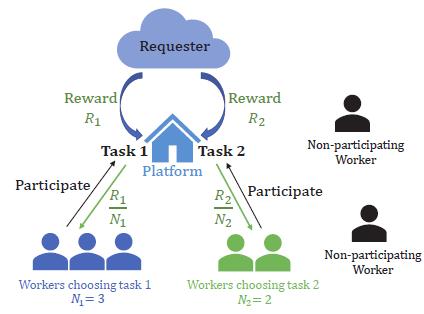
- Risk preferences in spectrum investment and mobile data trading decisions: An agent often needs to face uncertainty when making his decision. Traditionally, the expected utility theory (EUT) is widely adopted in the resource allocation literature, which assumed that the agent aims to maximize his expected utility. However, this formulation did not take into account the human’ risk preference, which is often risk-averse when gaining utility, but risk-seeking when losing utility. Thus, to model the risk attitude, we adopted the prospect theory, which is a Nobel-prize-winning behavioral economics theory developed by Daniel Kahneman and Amos Tversky. We have considered spectrum investment in cognitive radio networks in [1] and mobile data trading in [2]. Furthermore, we summarized the recent progress in the application of prospect theory in communication networks in [3].
- Cognitive limitations in crowdsourcing: Existing crowdsourcing mechanisms usually considered fully rational workers with the same and infinite cognitive reasoning level. As a result, the workers’ interactions are often formulated as a non-cooperative game with the Nash equilibrium as the solution concept. However, recent experimental studies in psychology have shown that people often have heterogeneous and finite cognitive levels. Thus, in [4], we applied the cognitive hierarchy theory from behavioral economics to study the impact of bounded rationality on crowdsourcing design.
Selected Publications
-
Junlin Yu, Man Hon Cheung, and Jianwei Huang, “Spectrum Investment under Uncertainty: A Behavioral Economics Perspective,” IEEE Journal on Selected Areas in Communications (Special Issue on Spectrum Sharing and Aggregation for Future Wireless Networks), vol. 34, no. 10, pp. 2667–2677, Oct. 2016.
-
Junlin Yu, Man Hon Cheung, Jianwei Huang, and H. Vincent Poor, “Mobile Data Trading: Behavioral Economics Analysis and Algorithm Design,” IEEE Journal on Selected Areas in Communications (Special Issue on Human-In-The-Loop Mobile Networks), vol. 35, no. 4, pp. 994-1005, Apr. 2017.
- Man Hon Cheung and
Junlin Yu, "Prospect Theory for Communication Networks," in
Encyclopedia of Wireless Networks, Springer, 2018.
-
Qi Shao, Man Hon Cheung, and Jianwei Huang, “Crowdsourcing with Bounded Rationality: A Cognitive Hierarchy Perspective,” in Proc. of IEEE Globecom, Abu Dhabi, UAE, Dec. 2018.