JPEG Encoder and Decoder
Presentation
This project was developed for the Multimedia Technologies and Applications course in City University of Hong Kong during the Semester A 2009/2010.
The goal of the project is to understand better how image compression works. We chose the JPEG method of compression because it is one of the most popular. JPEG is a lossy compression method, which removes information from the image.
The encoding process consists of the following steps:
- Transform RGB to YIQ or YUV and subsample color
- Perform DCT on images blocks
- Apply Quantization
- Perform Zigzag ordering and run-length encoding
- Perform Entropy coding
To decode the a JPEG image, these steps must be applied in the opposite way.
Features
The program has the following features:
- Choose the picture to encode.
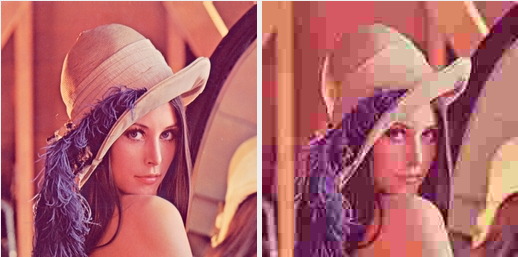
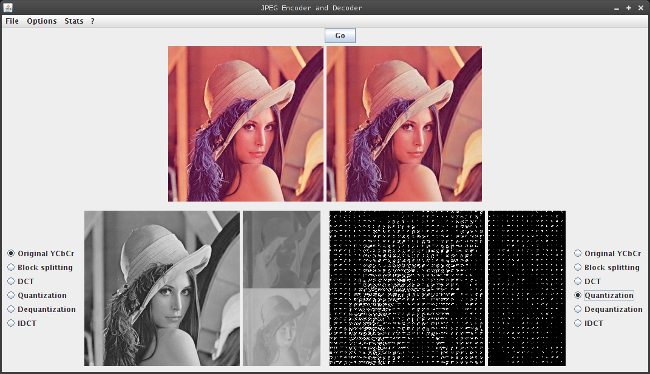
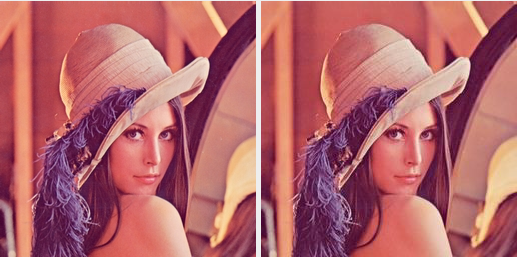
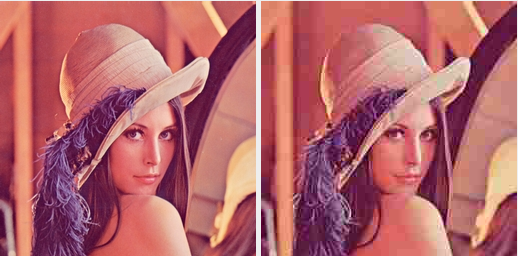
- View the original image and the resulting image. The resulting image has been encoded an decoded by the program.
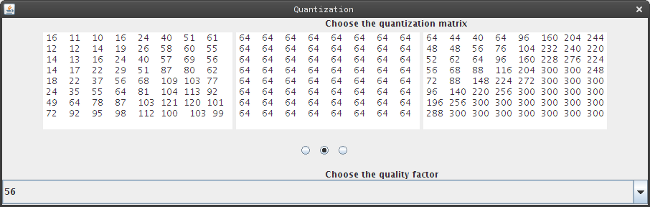
- Choose the quantization coefficient. 1 is the best quality, without any loss and 100 is the worst.
- Choose the quantization matrix for the luminance. The default matrix is the default quantization matrix for the JPEG compression.
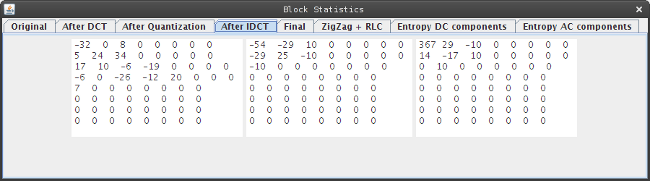
- View the details of a block. A block is a square of 64 pixels.
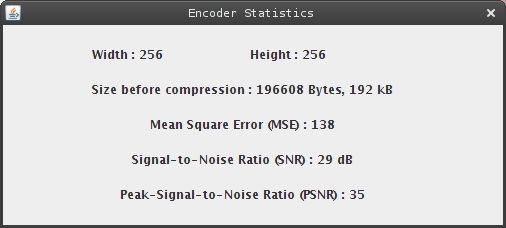
- View the size of the image.
- View the Mean Square Error, the Signal-to-Noise Ratio and the Peak-Signal-to-Noise Ration.
Download
Contact
51720666 Vincent Legout vincent@legout.info
51567250 Li Jia pnz116@gmail.com
51738610 Huang Xiao xiaohuang9@student.cityu.edu.hk
Screenshots
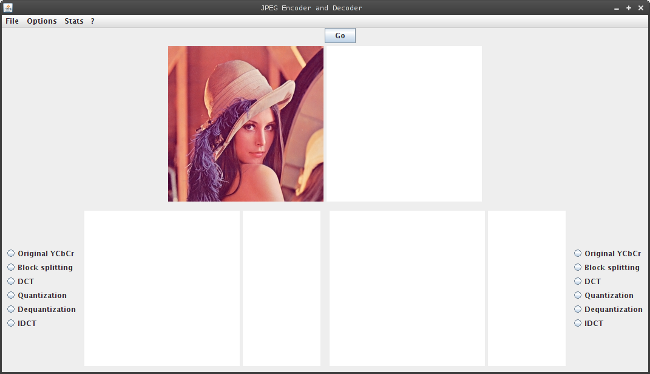
Initial State
After Running
Option Dialog
Block Dialog
Encoder Statistics
Encoded Image with Q=1
Encoded Image with Q=40
Encoded Image with Q=90