import matplotlib.pyplot as plt
import numpy as np
from Bio import Phylo

%matplotlib widget
In this notebook, we continue to cluster the instances in the iris 2D dataset without looking at the class attribute. In particular, we will use the hierarchical clustering algorithm that implements the agglomerative nesting (AGNES) for different cluster distance measures.
Classes-to-clusters evaluation
Similar to the last tutorial, use the Cluster panel to cluster the iris.2D dataset (not not iris dataset):
- Using the
Preprocesspanel, loadiris.2D.arfffrom the Weka data folder. - Using the
Clusterpanel, choose theClustererasHierarchicalClusterer. - The default number of clusters is . Change it to instead, i.e., set
numClustersto 3. - Select
Classes to clusters evaluationas thecluster mode.[1] - Click
Startto run the clustering algorithm.
Single-linkage method
The default linkage criterion (linkType) is SINGLE, which means that the hierarchical clustering algorithm iteratively links/merges two clusters and into one to minimize the cluster distance defined as
namely, the minimum distance between points in different clusters. This gives the single-linkage clustering solution.
# YOUR CODE HERE
raise NotImplementedError()
error_rateYOUR ANSWER HERE
Complete-linkage method
Repeat the hierarchical clustering procedure with linkType set to COMPLETE. The distance between two clusters is now measured by
which is the maximum distance between points in different clusters. The measure gives the complete-linkage clustering solution.
# YOUR CODE HERE
raise NotImplementedError()
error_rateYOUR ANSWER HERE
Dendrogram
To visualize the dendrogram in Weka,
- right-click the clustering result buffer, and
- select
Visualize tree.
You should see the dendrogram below for the complete linkage method:
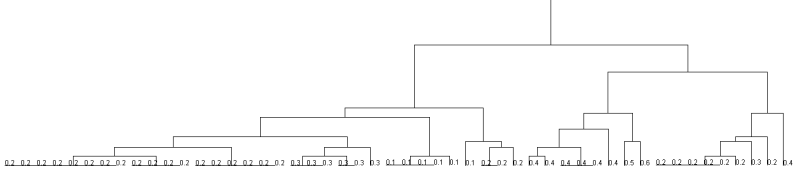
There are two issues with the dendrogram:
- The dendrogram is incomplete and only contains nodes for the first cluster. The agglomerative clustering stopped immediately after having
numClusters = 3clusters. - The leaf nodes have names that are fractions. By default, the names are taken from the last attribute other than the ignored class attribute. In this case, a name such as 0.2 is a
petalwidth, which is not helpful in identifying the samples or evaluating the clustering solution.
To fix the above issues:
- Set
numClustersto 1 so that the agglomerative clustering continues to merge all nodes into a single cluster. - In the preprocess panel, create a new attribute,
ID, as the last attribute to name the leaf node uniquely. You can copy the following configuration into theFilterpanel:weka.filters.MultiFilter -F "weka.filters.unsupervised.attribute.AddID -C last -N ID" -F "weka.filters.unsupervised.attribute.NumericToNominal -R last" -F "weka.filters.unsupervised.attribute.NominalToString -C last"
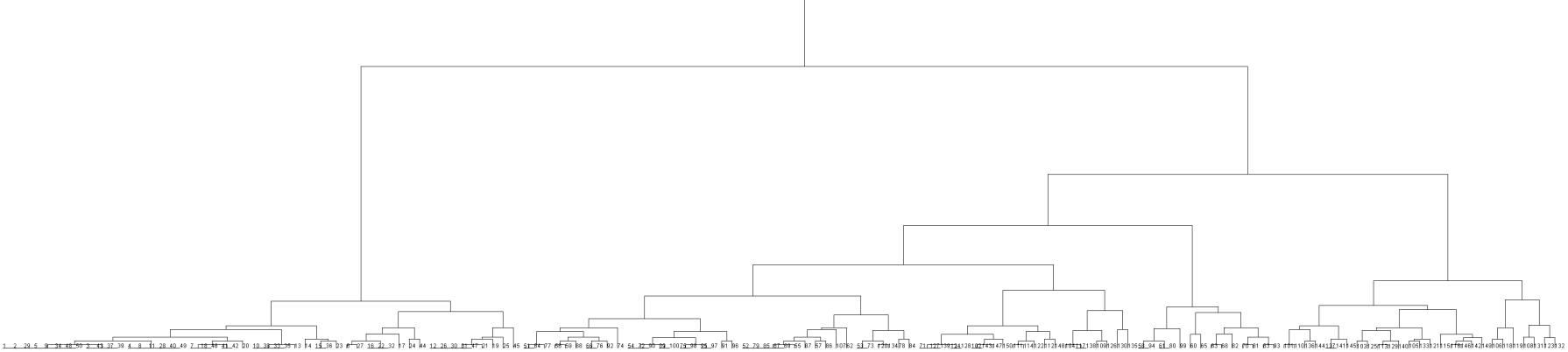
After applying the filter and rerunning the clustering algorithm with numClusters = 1 and class attribute ignored, the resulting dendrogram is as follows:
YOUR ANSWER HERE
The visualization is hard to read/analyze, especially for a large data set. The height is also not labeled.
Indeed, the dendrogram is printed in the result buffer as a phylogenetic tree in the Newick format with distances and leaf names. E.g., the dendrogram obtained by the complete linkage method is printed as:
Cluster 0
(((((((((((1:0,2:0):0,29:0):0,(5:0,9:0):0):0,((34:0,48:0):0,50:0):0):0.01695,((3:0,43:0):0,(37:0,39:0):0):0.01695):0.01695,((4:0,(8:0,11:0):0):0,(28:0,(40:0,49:0):0):0):0.0339):0.01982,(((7:0,(18:0,46:0):0):0.01695,(41:0,42:0):0.01695):0.01695,20:0.0339):0.01982):0.03625,(((10:0,38:0):0,(33:0,35:0):0):0.01695,13:0.01695):0.07301):0.01746,(14:0.04498,((15:0,36:0):0.0339,23:0.0339):0.01108):0.06245):0.11748,(((((6:0.01695,27:0.01695):0.01695,((16:0,22:0):0,32:0):0.0339):0.0339,17:0.0678):0.02982,(24:0.04498,44:0.04498):0.05264):0.07663,((((((((12:0,26:0):0,30:0):0,31:0):0,47:0):0.01695,21:0.01695):0.02803,19:0.04498):0.00873,25:0.05371):0.04391,45:0.09762):0.07663):0.05066):1.11921,(((((((((51:0,64:0):0.01695,77:0.01695):0.06263,(((56:0.01695,59:0.01695):0.01695,88:0.0339):0.01982,((66:0,76:0):0.0339,92:0.0339):0.01982):0.02586):0.01804,74:0.09762):0.04423,(((((54:0,72:0):0,90:0):0.01695,(89:0,100:0):0.01695):0.0339,((75:0,98:0):0.01695,(95:0,97:0):0.01695):0.0339):0.02873,(91:0.0339,96:0.0339):0.04568):0.06227):0.10672,(((((((((52:0,(79:0,85:0):0):0,67:0):0,69:0):0.01695,55:0.01695):0.01695,87:0.0339):0.01982,(57:0.0339,86:0.0339):0.01982):0.03625,107:0.08996):0.00766,62:0.09762):0.06153,(((53:0,73:0):0.0339,(120:0.01695,134:0.01695):0.01695):0.05114,(78:0.04498,84:0.04498):0.04006):0.07411):0.08942):0.14931,(((((71:0,(127:0,139:0):0):0.01695,(124:0,128:0):0.01695):0.04879,(((102:0,143:0):0.01695,147:0.01695):0.02803,150:0.04498):0.02076):0.04169,(((111:0.01695,114:0.01695):0.01695,122:0.0339):0.04568,(112:0.04498,148:0.04498):0.03459):0.02785):0.1693,(((104:0.01695,(117:0,138:0):0.01695):0.0678,(109:0.0339,126:0.0339):0.05085):0.09518,(130:0.08996,135:0.08996):0.08996):0.0968):0.12116):0.1883,((((58:0,94:0):0.0339,(61:0,80:0):0.0339):0.06054,99:0.09443):0.10278,((60:0.06574,65:0.06574):0.10434,(((63:0.01695,68:0.01695):0.05085,82:0.0678):0.02982,((70:0.01695,81:0.01695):0.03676,(83:0.01695,93:0.01695):0.03676):0.04391):0.07246):0.02714):0.38897):0.24263,(((((101:0.01695,110:0.01695):0.07301,(136:0.0339,144:0.0339):0.05607):0.01746,((137:0,141:0):0.04498,145:0.04498):0.06245):0.09715,((((103:0.0339,125:0.0339):0.05085,((113:0.01695,129:0.01695):0.01695,140:0.0339):0.05085):0.01288,((105:0.0339,133:0.0339):0.01108,121:0.04498):0.05264):0.0868,(115:0.06574,(((116:0.01695,146:0.01695):0.01695,142:0.0339):0.01695,149:0.05085):0.01489):0.11868):0.02016):0.1177,(((106:0.04498,118:0.04498):0.05264,119:0.09762):0.13421,((108:0.05371,131:0.05371):0.05619,(123:0.05085,132:0.05085):0.05905):0.12193):0.09046):0.50654):0.5153)
For the above to be a proper newick format,
Cluster 0should be removed as it is not part of the Newick format; and- a semi-colon
;should be added to the end to complete the definition of a tree.
The text file complete.tree fixes the above issues:
The tree can be loaded using:
from Bio import Phylocl_tree = Phylo.read("complete.tree", "newick")
def plot_tree(tree, **kwargs):
Phylo.draw(
tree,
branch_labels=lambda c: (l := c.branch_length)
and l > 0.1
and f"{l:.4g}"
or None,
**kwargs,
)
plt.gcf().set_size_inches(10, 20)
plt.title("Phylogenetic tree")
plt.tight_layout()
plot_tree(cl_tree)To obtain the 3 clusters returned by Weka with :
cl_clusters = [cl_tree.clade[0], cl_tree.clade[1, 0], cl_tree.clade[1, 1]]
cl_clustersTo plot the clusters in different colors:
cl_tree.root.color = "grey"
for c, color in zip(cl_clusters, ["red", "blue", "green"]):
    c.color = color
plot_tree(cl_tree)
To obtain the leaf nodes for each of the clusters:
cl_clusters_leaves = [[i.name for i in c.get_terminals()] for c in cl_clusters]
for j, leaves in enumerate(cl_clusters_leaves):
print(f'Cluster {j} with {len(leaves)} nodes: \n{" ".join(leaves)}\n')To obtain the cophenetic distance of the root, i.e., the cluster containing all nodes, we can compute the total branch distance from the root to any leaf node, say node 1:
cl_d0 = cl_tree.distance("1")
cl_d0
The second largest cophenetic distance at the root splits into 2 clusters is:
cl_d1 = cl_d0 - cl_tree.root.clades[1].branch_length
cl_d1
The minimum and maximum cophenetic distance at which we have 3 clusters is:
cl_max_distance, cl_min_distance = cl_d1, cl_d1 - min(
    c.branch_length for c in cl_clusters
)
cl_max_distance, cl_min_distance
plot_tree(
cl_tree,
axvspan=((cl_d0 - cl_max_distance, cl_d0 - cl_min_distance), {"facecolor": "0.8"}),
)# YOUR CODE HERE
raise NotImplementedError()
sl_max_distance, sl_min_distance# tests
assert np.isclose(sl_max_distance - sl_min_distance, 0.006629999999999997, rtol=1e-3)To obtain the largest cophenetic distance at which we have at least three clusters:
# YOUR CODE HERE
raise NotImplementedError()YOUR ANSWER HERE